E. Michael Mitchell was a Canadian-born illustrator and artist best known for designing the original dust jacket for J.D. Salinger’s 1951 novel The Catcher in the Rye. He also spent part of his later career teaching artists and animators, including students in the Character Animation program at CalArts.
I was fortunate to study with Mitchell during my time in the Character Animation program at CalArts. To me he was Mike, an experienced artist and patient instructor whose classes encouraged observation, experimentation, and drawing without becoming trapped by a rigid formula.
Long before I knew much about his career, I knew him as a teacher. Learning later about his illustration work, his friendship with J.D. Salinger, and the famous book jacket he designed gave me a different appreciation for the range of experience he brought into the classroom.
Who Was E. Michael Mitchell?
E. Michael Mitchell was born in Canada in 1920 and worked as an illustrator, designer, visual-development artist, and teacher during a career that spanned much of the twentieth century.
His name is now most closely associated with The Catcher in the Rye, but his work crossed several areas of commercial and entertainment art.
What interests me most about Mitchell is that his work did not feel confined to one narrow definition of illustration. He could approach a drawing as an image, a design problem, or a visual idea. That same willingness to explore different possibilities was something I remember from studying with him.
E. Michael Mitchell and The Catcher in the Rye
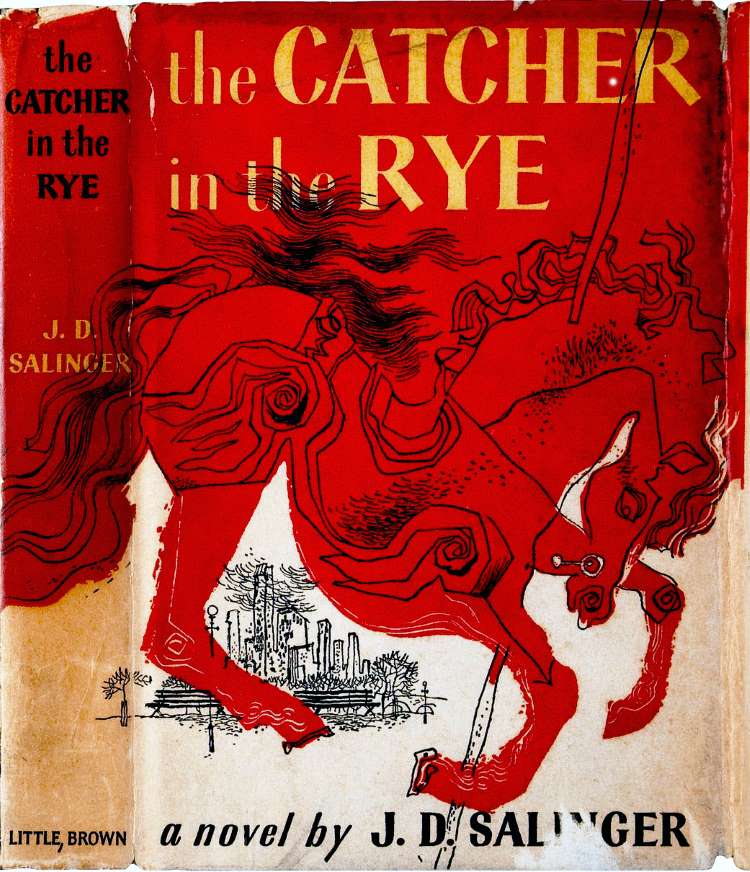
Mitchell designed the illustrated dust jacket for the first edition of J.D. Salinger’s The Catcher in the Rye, published by Little, Brown and Company in 1951.
The design is dominated by a red background and an expressive carousel horse rendered with loose black linework. Rather than illustrating Holden Caulfield literally, Mitchell created an image that feels symbolic, strange, and emotionally unsettled.
That decision is part of what makes the cover so memorable. It doesn’t explain the story. It gives the reader an image with enough ambiguity to remain interesting after the book has been read.
The jacket has become inseparable from the visual identity of the novel, and bibliographic records for the first edition specifically credit E. Michael Mitchell with its design.
His Friendship With J.D. Salinger
Mitchell’s connection with Salinger went well beyond a single book-cover commission.
The two were longtime friends, and Salinger continued corresponding with Mitchell long after becoming famously private. A collection of Salinger’s letters to Mitchell spans decades, from the early 1950s into the 1990s.
That correspondence gives the jacket an interesting context. Mitchell wasn’t simply an anonymous commercial illustrator assigned to a novel. He knew the author personally and remained part of Salinger’s life long after The Catcher in the Rye was published.
Studying With E. Michael Mitchell at CalArts
My connection to Mike is much more personal. I studied with him while I was in the Character Animation program at CalArts.
What stands out in my memory is how encouraging he was with students at different skill levels. His classroom wasn’t built around everyone producing the same type of drawing. The setups gave us opportunities to observe, experiment, see how other students approached the problem, and develop our own instincts.
That way of learning stayed with me.
My own drawing process is still primarily observational. I look for the large shapes created by form, light, and shadow before moving toward smaller details. I don’t like reducing every subject to a predetermined sequence of circles and construction lines.
Mike’s classes reinforced the idea that drawing could be exploratory. A drawing could be a way of thinking rather than simply a procedure for arriving at a polished picture.
If you’re interested in what studying drawing in that environment was like, I have a separate guide with my CalArts sketchbook tips.
What I Learned From His Approach to Drawing
I don’t remember Mike’s classes as a collection of tricks or formulas. What I remember is the atmosphere of experimentation.
That matters because drawing can become surprisingly rigid when you’re always trying to produce the correct result. An experienced artist can sometimes become more interesting by allowing uncertainty back into the process.
- Observe before deciding what the drawing should look like.
- Work with the major shapes before becoming distracted by details.
- Try different visual solutions instead of assuming there is one correct approach.
- Let drawings remain exploratory when they need to.
- Pay attention to the ideas behind an image, not only the rendering.
Those ideas continue to influence the way I think about drawing today.
Mitchell’s Illustration Style
The Catcher in the Rye jacket is a useful example of why Mitchell’s work is worth studying.
The horse is recognizable, but it isn’t treated as straightforward realism. The drawing twists, breaks apart, and becomes part of the graphic design of the jacket.
That balance between representation and abstraction is more interesting to me than simply asking whether an illustration is realistic.
A drawing can describe a subject clearly while still exaggerating line, shape, rhythm, scale, or composition. Mitchell’s work is a reminder that observation doesn’t require literal rendering.
How to Study E. Michael Mitchell’s Art
If you like Mitchell’s work, I wouldn’t try to reproduce his style line for line. Instead, isolate one decision that interests you and turn it into a drawing exercise.
- Draw a familiar animal and simplify it until the shapes begin to feel graphic.
- Use expressive lines rather than carefully polishing every contour.
- Design an image for a story without drawing the main character.
- Start with a real reference and deliberately exaggerate one shape.
- Combine recognizable drawing with areas of abstraction.
- Create a book-cover image based on mood instead of illustrating a literal scene.
These kinds of exercises are more useful than trying to make a perfect imitation because they force you to understand the visual decision behind the artwork.
If you want more subjects and approaches to experiment with, browse my broader collection of drawing ideas.
Why I Still Remember Mike
It’s easy to reduce an artist’s life to credits, dates, and famous projects. That isn’t how I remember E. Michael Mitchell.
I remember an experienced artist who still made time for students.
He brought decades of professional experience into the classroom without making drawing feel inaccessible. He encouraged students to experiment, look closely, and keep developing their own visual instincts.
Knowing that the same person teaching us had created one of the most recognizable book jackets of the twentieth century makes those memories more meaningful now than they were when I was sitting in class.
For me, his legacy isn’t only the Catcher in the Rye cover. It is also the influence he had on generations of young artists who encountered him as a teacher.
For more drawing techniques, exercises, books, and ideas, continue to my main drawing guide.